Understanding the Dynamics of the AI Ecosystem with Pace Layers
When a sector goes too fast, it loses support
Without a doubt, the pace of the AI ecosystem is dizzying. Just processing it all is difficult enough. Scaffolding it, finding themes, and understanding the shape of it is nearly impossible.
Recently, Mike Migurski introduced me to Stewart Brand’s Pace Layers, a framework for organizing fields and categories by how fast they change. Brand writes:
Consider the differently paced components to be layers. Each layer is functionally different from the others and operates somewhat independently, but each layer influences and responds to the layers closest to it in a way that makes the whole system resilient.
From the fastest layers to the slowest layers in the system, the relationship can be described as follows:
Fast learns, slow remembers. Fast proposes, slow disposes. Fast is discontinuous, slow is continuous. Fast and small instructs slow and big by accrued innovation and by occasional revolution. Slow and big controls small and fast by constraint and constancy. Fast gets all our attention, slow has all the power.
In The Clock of the Long Now, Brand proposes six macro layers that represent a “healthy civilization”, as seen below:
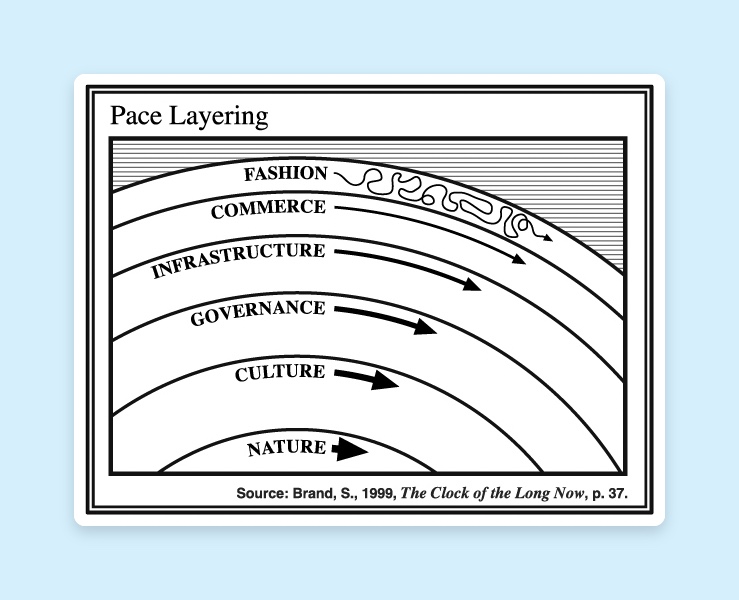
Imagine: as these layers move at different rates, friction builds between them, slowing the upper layer and quickening the lower. This negotiation, translation, between the layers is constructive when their speeds are different, but in balance. When they’re not, things get weird.
Brand writes:
In a durable society, each level is allowed to operate at its own pace, safely sustained by the slower levels below and kept invigorated by the livelier levels above… Each layer must respect the different pace of the others. If commerce, for example, is allowed by governance and culture to push nature at a commercial pace, then all-supporting natural forests, fisheries, and aquifers will be lost. If governance is changed suddenly instead of gradually, you get the catastrophic French and Russian revolutions. In the Soviet Union, governance tried to ignore the constraints of culture and nature while forcing a five-year-plan infrastructure pace on commerce and art. Thus cutting itself off from both support and innovation, it was doomed.
The last 10 days have been a whirlwind of conferences: Foo Camp, Open Frontier, AI Engineering World’s Fair… Every night I’d come home and scribble down notes, hoping a structure or two would emerge to bring it all together.
I think Pace Layers is the best I’ve got:
Dwelling on this, a few stray notes emerge:
- So much of the current AI backlash can be linked to massive investment forcing lower layers to move faster than normal. Data centers are moving faster than the culture above them (the organizations, governance, and universities), charging the debate around their buildout with incredible emotions.
- Further, the speed of the data center layer should move faster than energy production, but if it moves too quickly we go from light friction to earthquake level seismic effects. Usually, data centers could probably be slotted in the “decades” bucket (from proposal to completion), but at the moment we’re pulling them into mere “years.”
- The advancements of models over the last 18 months or so have been driven by hired and synthetic data; the organic human data is essentially tapped. We’re not going to get another internet.
- The incredible speed of the first 2-5 layers are functioning as feedback to the models, hired expert data, and training methods layers. Because the layers below the training methods are just so much slower than the upper layers. This lack of feedback from the layers that usually support the upper ones is an issue. The upper layers (incredible as they are!) are screaming ahead while organizations and universities continue apace, unable to support their speed.
- This is why you can go to the AI Engineering World’s Fair and come away thinking everyone is building dark factories and automating entire enterprises, while non-developers from outside the greater-San Francisco AI complex wonder why data centers are necessary.